The “New-ness” Gifted Children Seek in Familiar Spaces, especially in Nature
-by Ketika Kasetwar, May 2026
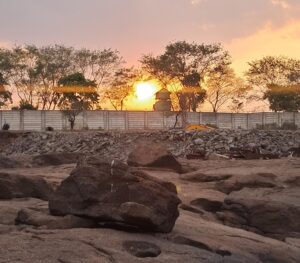
Recently, we visited a river-side ‘touristy’ place. Not a new one for us, but one that we have been visiting for years.
At one point during the visit, we stood watching the river for a long time, noticing how the water moved differently around certain rocks compared to another section nearby. What began as a simple observation slowly turned into a chain of thoughts, about speed, pressure, depth, sound, erosion, and how tiny changes in the shape of a surface can completely alter the movement of water.
A little later, the same place became something else entirely.
The conversation shifted from flowing water to why some spaces in nature feel calming while others feel overstimulating. Then to crowd behaviour. Then to why humans are naturally drawn towards rivers and mountains. Then to how every visit to the same place somehow feels different despite the location remaining unchanged. And finally, a sad one around what must have happened when the tragedy struck there last year and so many people lost their lives – while observing the mangled remains of the bridge that we have happy memories with from the past.
And somewhere during these conversations, I found myself thinking again about something I have observed very often with gifted and high-ability learners:
Many gifted children are not constantly seeking “new things.” They are often seeking new-ness within familiar things.
From the outside, gifted children are frequently described as children who “get bored easily.” While that can sometimes be true, I think what is often missed is why they get bored.
Many of them do not necessarily lose interest because something is repetitive. They lose interest when there is no room left for discovery, variation, complexity, or deeper engagement.
A familiar environment that keeps revealing new layers can hold their attention for years.
This is why many gifted children:
- watch the same documentary repeatedly but notice something new each time,
- revisit the same topic obsessively from different angles,
- return to the same games while changing the rules or strategies,
- re-read books while analysing different character motivations,
- walk through the same neighbourhood but keep discovering new patterns, details, or questions.
The “new-ness” is not always in the environment itself. Sometimes, it is in the way their mind keeps interacting with it.
I think this is one reason many gifted children deeply enjoy nature-based experiences. Nature constantly changes while still remaining familiar. The same river behaves differently after rainfall. The same tree looks different in another season. The same trail feels different depending on the time of day, the crowd, the weather, or even the child’s emotional state that day. There is predictability. But there is also variation. And that combination can be deeply regulating and intellectually engaging for many high-ability learners.
I have observed similar patterns beyond nature too. Some gifted children repeatedly dismantle and rebuild the same objects, not because they have run out of toys, but because they are exploring new possibilities within the same system. Some revisit familiar conversations with adults years later, this time with more nuanced questions. Some become intensely attached to a handful of interests, but continue expanding those interests in increasingly sophisticated ways over time.
Unfortunately, many educational environments misunderstand this pattern.
We often assume learning only happens through constant introduction of new content: new chapters, new worksheets, new assignments, new topics, new assessments and new ‘friends’.
But for many gifted learners, meaningful learning also happens through revisiting, rethinking, refining, comparing, questioning, and seeing familiar things differently over time. Depth is often mistaken for repetition. And repetition without depth quickly becomes disengaging.
This is also why many gifted children resist highly structured learning environments that leave little room for exploration. When every outcome is predefined, every answer expected, and every process standardised, there is very little opportunity for children to interact with ideas in personally meaningful ways.
What I witnessed yesterday at Kundmala was not “teaching”, or even “learning” in the conventional sense.
It was simply space. Space to observe. Space to think aloud. Space to notice patterns. Space to connect unrelated ideas. Space to revisit familiar thoughts in new ways.
And perhaps that is something many gifted children quietly need far more than we realise. Not constant stimulation. Not endless novelty.
But environments that continue to leave room for discovery.